Sunday Brunch: Can we rely too much on one technology ?
Much of the time it's right to argue that we need to focus on 'everything, everywhere, all at once'. But not always. Sometimes, when we look at sustainability challenges from an investor perspective, expecting new technology to solve our problems is too risky.

I have frequently argued that when it comes to investing in solutions to our sustainability challenges, picking one solution and ignoring the others is wrong (or just plain stupid). And that in many cases we can go further and argue that in many cases we should try almost any potential solution. Even those that require a lot of investment or that are technologically complex. I recently wrote about this in the context of cement/concrete production. But the principle applies more widely.
 Steven Bowen
Take agriculture/food. Ideally, for both health and planetary reasons, we want many people to eat less meat. But in the meantime we need to reduce the impact of the meat we do eat. And this is likely to involve all sorts of actions from reducing cow burbs, through fertiliser management, to land use and alternative proteins. Pretty much nothing should be off the table. Including more intensive agriculture (with safe guards).
But this is not always the case. Sometimes, at least from an investor perspective, focusing on a expensive, capital intensive solutions can soak up too much of the available investment. And they can result in us doing nothing for an extended period, hoping that the one big technological solution will eventually solve everything.
If the solutions being funded look like they are going to always struggle from a profitability perspective, then we might be better off letting someone else take the first mover risks.
One such example is probably green hydrogen.
Will green hydrogen ever make financial sense?
Regular readers will know that I am a sceptic when it comes to the widespread use of green hydrogen. Theoretically green hydrogen can replace all sorts of other fuel sources. The 2024 IEA Global Hydrogen Review talked about potential uses including the replacement of existing (dirty ie fossil fuel based) hydrogen in applications such as refining. Plus they discussed using green hydrogen in transport, steel production, energy storage, and chemical feedstock production.
But, outside of replacing existing hydrogen use (around 100 MT pa), it's hard to see many of the alternative applications making financial sense.
Regular readers will be familiar with Michael Liebreich's Hydrogen ladder (now on V5).
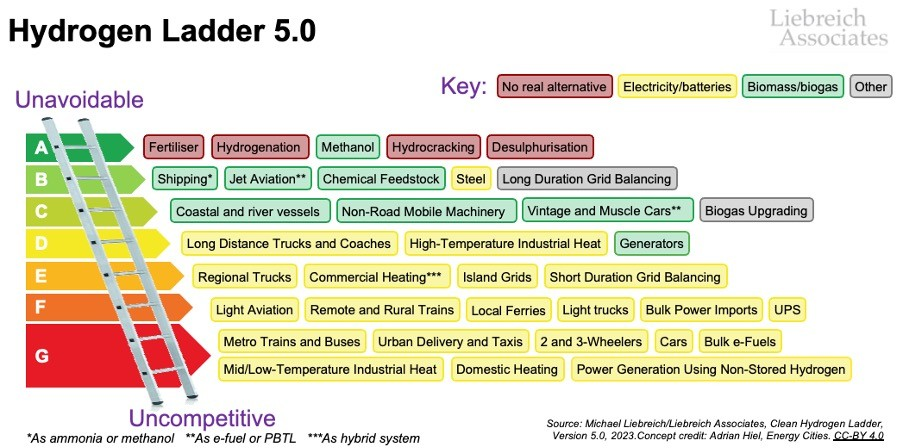
The bottom line of the ladder is that for most applications being proposed for green hydrogen, other (and better) solutions exist. You can read more about the ladder in a recent Nature Reviews clean technology article (sorry pay walled). In addition, Michael very kindly posts extensively on the topic, including this 2023 Substack article. In it he makes a few changes to the older version of the ladder (promoting Jet Aviation, Regional Trucks and Short Duration Grid Balancing). These are now B, and 2x E respectively. For those not familiar with the letter system, anything below a C is seen as only having a plausible small market share or worse.
One conclusion that could be drawn from these changes is that future promotions are also possible. From an investor perspective, this suggests at best a 'wait and see' rather than a 'rush in now'.
One final point to note before moving on is that most of the A applications are replacements for the existing uses of hydrogen, such as in fertiliser production and refining. This is not a trivial switch. According to the 2025 IEA Global Hydrogen Review....
"Global hydrogen demand increased to almost 100 million tonnes (Mt) in 2024, up 2% from 2023. This rise was driven by greater use in sectors that have traditionally consumed hydrogen, like oil refining and industry. The supply of hydrogen continued to be dominated by fossil fuels, using 290 billion cubic metres (bcm) of natural gas and 90 million tonnes of coal equivalent (Mtce)."
They also made the point that demand from new applications accounted for less than 1% of the total and was almost entirely concentrated in biofuels production. And that while low-emissions hydrogen production grew by 10% in 2024 it still accounts for less than 1% of global production.
One key factor they identified in the low uptake (and remember the IEA is broadly a supporter of the increased use of green hydrogen) was cost. A recent article in the International Journal of Hydrogen Economy suggested that gray hydrogen, made using fossil fuels ($1.50–$2.50/kg) remains the most cost-effective production method. By comparison green hydrogen ($3.50–$6.00/kg) is currently the most expensive.
Despite all of this, the IEA estimates that low-emissions hydrogen production from projects that are today operational or that have reached Final Investment Decision is set to reach 4.2 Mtpa by 2030, a fivefold increase compared with 2024 production. Just as an aside, this is below the 2024 level of announced projects (due to cancellations etc), and well below government and industry ambitions at the start of this decade.
Why should we (as investors) be discussing this? My point is a simple one - many governments are still apparently planning for high levels of green hydrogen production. And they often want us to fund it.
Taking the UK (where I live) as an example. In July 2025 the government announced that "10 projects from the first phase of its flagship hydrogen programme – Hydrogen Allocation Round (HAR1) – can begin construction, supporting the government’s mission to become a clean energy superpower." They went on to say that this "follows the Spending Review which saw an extra £500 million confirmed for the first ever hydrogen transport and storage network as part of Britain’s industrial renewal, connecting hydrogen producers with vital end users". The HAR1 projects are expected to access over £2 billion over 15 years in revenue support from the Hydrogen Production Business Model.
A cynic would say that this was then, and that over the last 6-9 months since the UK government has become more lukewarm on green hydrogen. As evidence of this, the Hydrogen Energy Association 2026 report suggested that just over 40% (43.5%) of respondents to their survey said that their confidence in the business future of green hydrogen in the UK had worsened in the last 12 months. As an aside, the report is an interesting read is you want to understand a bit better the positive case for green hydrogen.


I also get that governments want to try all sort of different technologies. As argued above, sometimes we need to try 'everything, everywhere, all at once'. But when the long term financial case looks weaker, then every $ (or £ or Euro etc) we spend on one technology is money that is not available to spend elsewhere. Especially when it's government money. There are all sorts of projects that could give society a more immediate return, that are currently starved of capital.
Yes, green hydrogen promises much, but it's not clear in many use cases that it can financially deliver.
For those who are interested in the wider set of practical solutions to climate change, I would recommend the research of Project Drawdown. You may not agree with all of their recommendations (for instance they are positive on nuclear power - which is considered by many to be politically unacceptable) but I would argue that opening our thinking to other views on possible solutions will be an essential part of finding our way through the coming decades.

One last thought
It's not just green hydrogen that we are a bit cynic about from an investor perspective. Living as I do in Europe, the shift to electric buses looks strong, capturing a growing share of the new bus market. But from an investor perspective is this the full picture. Yes & No. Other questions we also need to ask - how many existing buses are electric, and where are the sales happening?
 Steven Bowen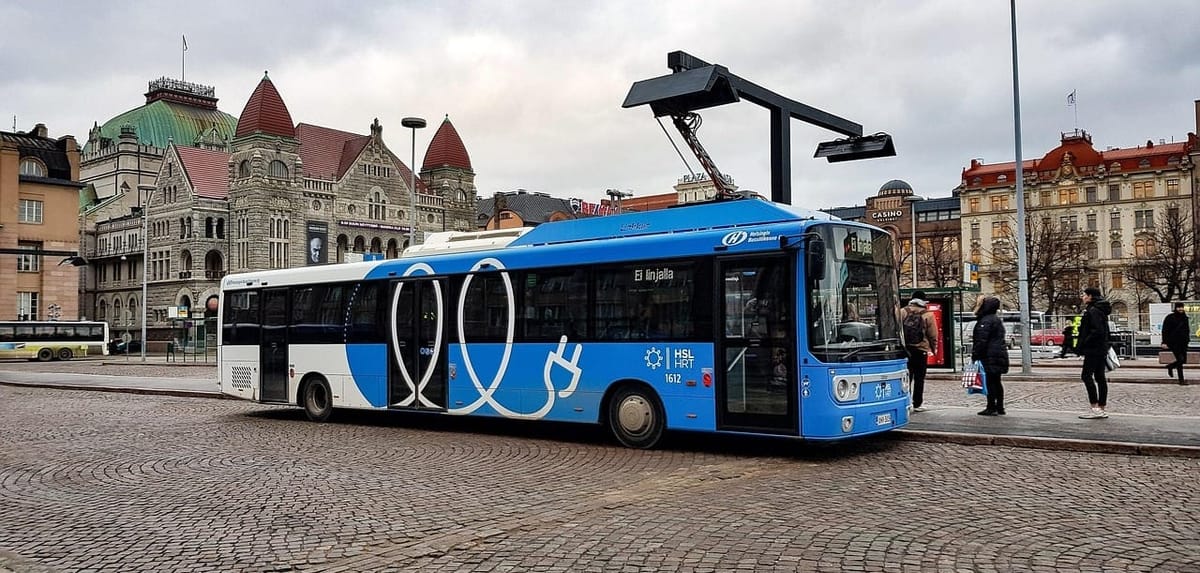
Grant me the strength to accept the things I cannot change, the courage to change the things I can, and the wisdom to know the difference. Reinhold Niebuhr - a Lutheran theologian in the early 1930's
Please read: important legal stuff. Note - this is not investment advice.