
Sunday Brunch: narratives - the stories we tell ourselves
Narratives drive financial markets, the story we tell ourselves comes first, and we often fit the data around it. A good narrative can be better than good financials. And the same applies to sustainability. People need a story to anchor their beliefs - so maybe focusing on numbers first is wrong.

"The shift from future climate risk to present reality raises difficult questions for governments, businesses, and risk professionals. Who is responsible when critical systems fail? And how do we communicate these risks in a way that cuts through technical jargon and reaches people at a human level? " - David Shukman, Fire & Flood: Lessons from Britain's new world of extremes.
As investors, we know that having a good narrative is really important. How companies and analysts sell narratives to investors can drive share price movements. Numbers count, but not as much as you think.
Do the same rules apply to sustainability. If we focus too much on the numbers, do we risk losing our audience? Is it better if we lead with relatable stories about real people, and follow with numbers when detail is needed? After all we know that politicians do not lead, they generally follow public opinion.
This has very real implications for investors, after all the frequent current default is that any proposed regulation will get watered down or delayed. If the public gets behind the proposed change, political foot dragging may be reduced.
Maybe the best way of delivering real change is not via back room policy engagement but by firing up the general public. In a way this is the underlying thesis behind David Shukman's book "The Response: A Story of Fire and Flood in Britain’s New World of Extremes".
The idea of finding a better way of reaching people on the issues (and solutions) around climate change is not a new one. Regular readers will know that we are big fans of the work of Professor Katherine Hayhoe. She is a climate scientist who believes that the best way of getting people to understand climate issues is to make the stories real to them. If you don't know her work, I highly recommend you have a look.

In a similar vein, I was recently listening to a GARP podcast, in which Jo Paisley (President of the Garp Risk Institute) interviewed the journalist and author David Shukman (this is another good podcast from the GARP team). As a journalist he wanted his recent book to cut through the jargon that often permeates how we write about climate change. And by doing so he wanted to make the impacts of climate change more understandable and very real to the average non specialist.
 David Shukman (Author) Format: Hardcover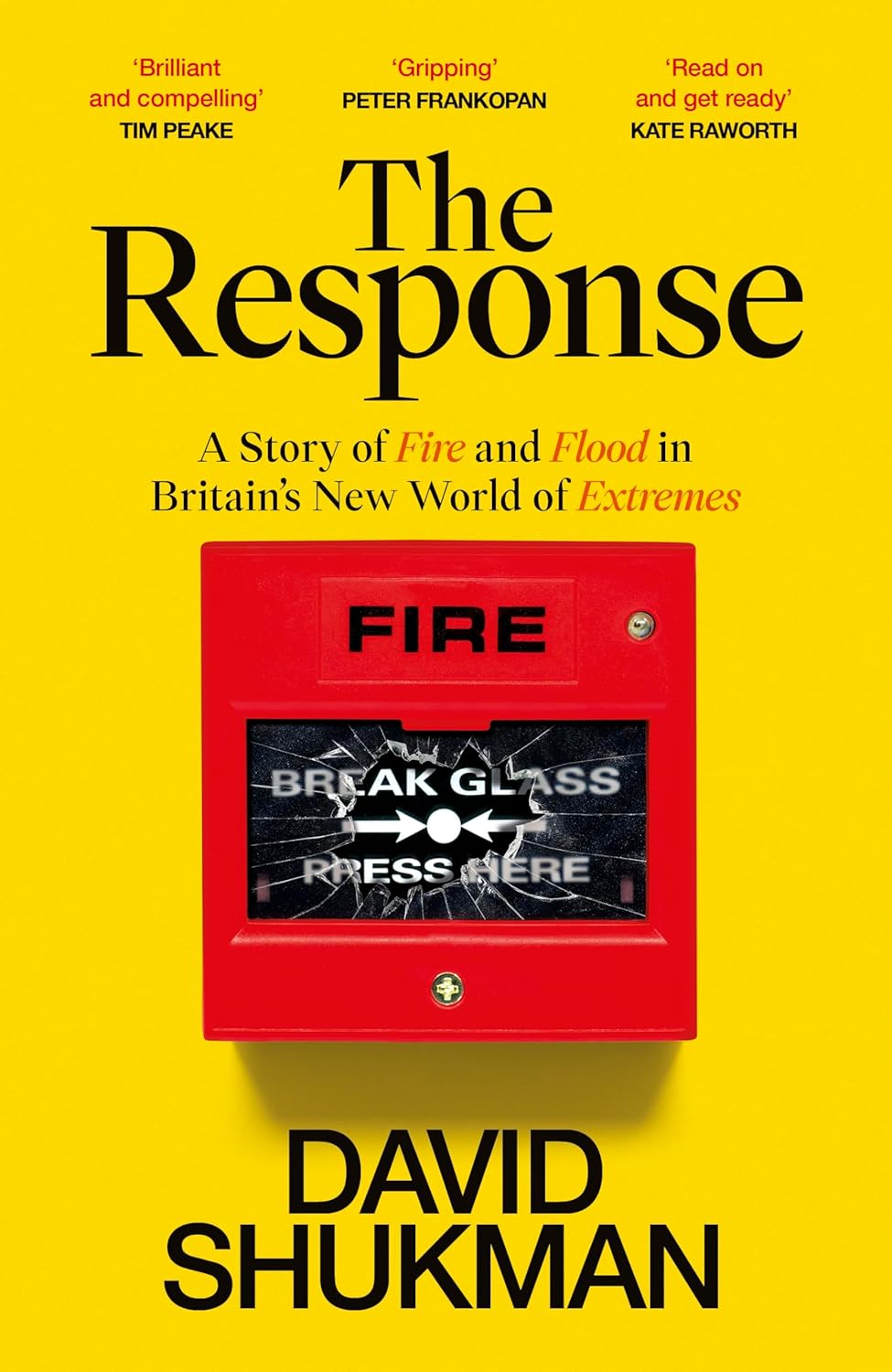
He does this by talking about the experiences of real people. And in doing so he indirectly makes the point that we can have all the policies, regulations, and plans we want, if they don't make a difference on the ground, then people will not see the benefit. And they will stop buying into our message.
We can see this around us all of the time. Discussions about achieving net zero get bogged down in debates about how they are 'negatively impacting people during our cost of living crisis'. Which in turn makes people less supportive of the investments we need to make. To be clear, opinion polls show that most people still get the imperative to reduce GHG emissions. But often they don't want to pay the upfront cost - or to misquote St Augustine "please God, make me good, but not just yet".
It's not that we don't have enough real life stories to use. People whose farms are devastated by drought, whose homes burn down in wild fires, whose properties are flooded over and over again, and who die in our overheated cities.
What does this mean from an investor perspective?
One argument is that we can often rely on politicians to change their minds, which means in turn that the first share price reaction to the threat of regulatory change will often be over stated. The cynical view is that lobbying will nearly always water down any regulation, and so it's 'safe' to assume that it will either have less impact than first thought, or be delayed, possibly for years.
 Steven Bowen
The other approach is to consider the type of pressure that politicians face. I argue that where politicians feel they are working with public opinion rather than against, they will be prepared to either go further, or be more willing to hold the line.
 Steven Bowen
A good example is the level of support (according to The Health Foundation mostly between 2/3 and 3/4) for further action on tobacco. By contrast support for action on unhealthy food and alcohol sits lower, somewhere between 37% and 62%. And interestingly, opposition seems highest to measures that aim to restrict alcohol sales or increase prices. So this could mean that investors should expect even tougher tobacco regulation in the future.
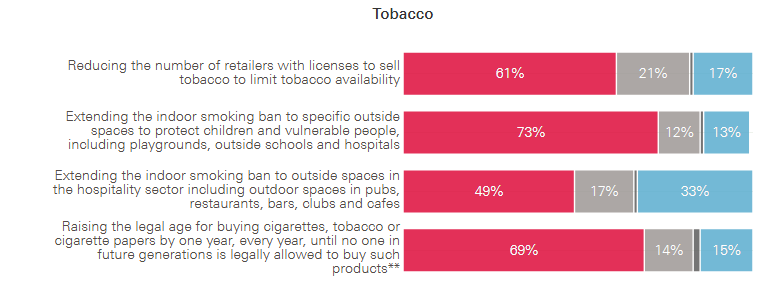
Maybe the bottom line for investors is to check public opinion before acting on regulatory news. And for sustainability professionals we need to find a way to tip public support up toward c. 75%. This would make it easier for politicians to act, and reduce the chances that they back down later.
One last thought
Finance people listen to narratives as well. And yet we often pretend that they don't. When finance people try to teach sustainability professionals how to value an investment opportunity, they normally get straight into the mathematical detail. Lot's of accounting (profit and loss, cashflow and balance sheets) and some very detailed forecasting of capex, profit margins, and depreciation. And by doing so they miss the most important step, the one that means the whole process make sense. And the one that you need hardly any financial knowledge to master.
That step is the narrative. What business is this company in, how will the industry change over the coming years/decades, why will customers buy their product or service, what competition will they face, and why will customers pay more for the product or service than it costs to make it?
 Steven Bowen
Grant me the strength to accept the things I cannot change, the courage to change the things I can, and the wisdom to know the difference. Reinhold Niebuhr - a Lutheran theologian in the early 1930's
Please read: important legal stuff. Note - this is not investment advice.