Sunday Brunch: near term industrial electrification
For investors, the decarbonisation of heavy industry is problematic. Many technologies need more development, and the economics are challenging. But this doesn't mean there is nothing we can do. Some solutions such as electrification are closer to commercial roll out at scale than you might think.

Let's start with the bad news. From an investor perspective, many of the technologies that will create more sustainable cement, virgin steel, and chemicals etc still need further R&D to take them to full technical and commercial viability. This is problematic given that just over a quarter of all GHG emissions (including indirect emissions attributed to external energy supply) come from Industrial applications.
From a purely financial perspective, we can look to ensure that the companies we are invested in are putting the 'right' amount of effort into long term R&D, but this is a process focused on 2035 and beyond.
But it's not all bad news. There are other levers we can pull. Electrification is a good (relatively) 'quick win' tool that we can use to at least partly decarbonise some industry activities.
PS - by quick win we mean the next few years, not always straight away. And by some, we mean around 10% now and maybe up to c. 37% in a few years time.
According to a recent White Paper produced by eight European research institutes (Strengthening Industrial Heat Pump Innovation - Decarbonizing Industrial Heat) ....
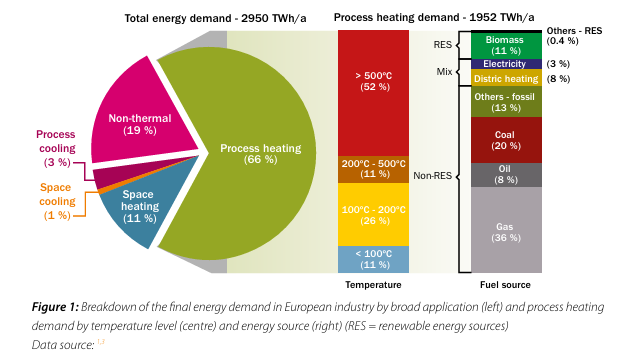
Across Europe the industrial sector is currently responsible for 25 % of final energy consumption and 20 % of the GHG emissions (not including indirect emissions attributed to external energy supply). And the majority (66 %) of industrial energy use is for process heating purposes.

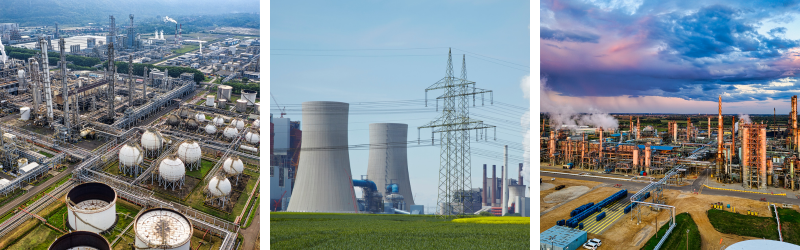
As we have flagged in earlier blogs, heat pumps (with or without thermal storage) are already a viable solution for most industrial heat applications up to c. 100C. And work is progressing to advance this limit up to 200C. To be clear, some heat pumps in some places already work at temperatures higher than 100C. What we are looking for is for them to be commercially viable pretty much everywhere using mature technology.
This means it's possible to largely decarbonise c. 11% of European industrial heat demand now, and up to 37% over the next few years.
That's the good news - basically in a 'few years' we could potentially see heat pumps replacing c. 1/3 of current industrial heat demand. Not perfect, but a good start.
You can probably tell that there is a BUT coming. After all if the case for heat pumps was already totally compelling and easy to deliver, then it would happen without investors having to do anything. No need for engagement and stewardship.
One barrier is industry structure. As the white paper points out ... there are limited installers and decision makers who understand both the capabilities of heat pumps AND the demands of the end industrial user. One solution to this is for investors to engage with heat pump manufacturers and potential heat pump users to get the option in front of decision makers in an informed way. And to advance R&D and product development.
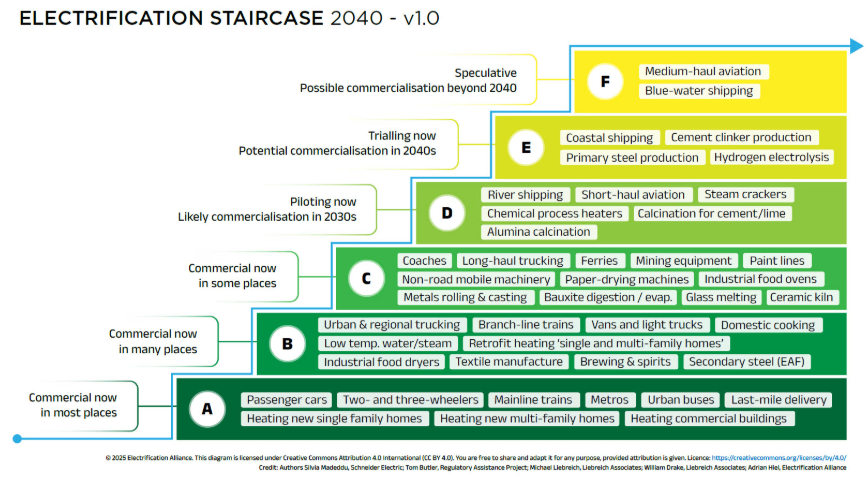
The other challenge is harder to fix (at least for investors). As the team behind the Electrification Staircase point out ....
"Electricity bills in Europe carry higher taxes, levies and network charges per unit of energy compared with gas. Such discrepancy is even more striking when considering that electricity taxes include surcharges that were introduced to finance the transition to renewable energy" – The Electrification Staircase.
It's not all bad, apparently the gap (ie the average electricity-to-gas price ratio) has dropped in recent years, but more needs to be done. As a recent Agora report sets out ...
"Electrification becomes cost competitive when the electricity-to-gas price ratio, including carbon costs, decreases from the current 3–5 range for the sectors in question to the 1.5–2.8 range." The Business case for electrifying industrial heat.


Fixing this is more of a policy debate. But even here investors have a financial role to play (in addition to lobbying), making clear to governments that the current structure for setting electricity prices not only holds back decarbonisation, it also acts as a drag on what could be a key future industry.
Because electrification of industrial processes opens up new opportunities for European companies, especially those involved in control systems. And this could result in a massive export market.
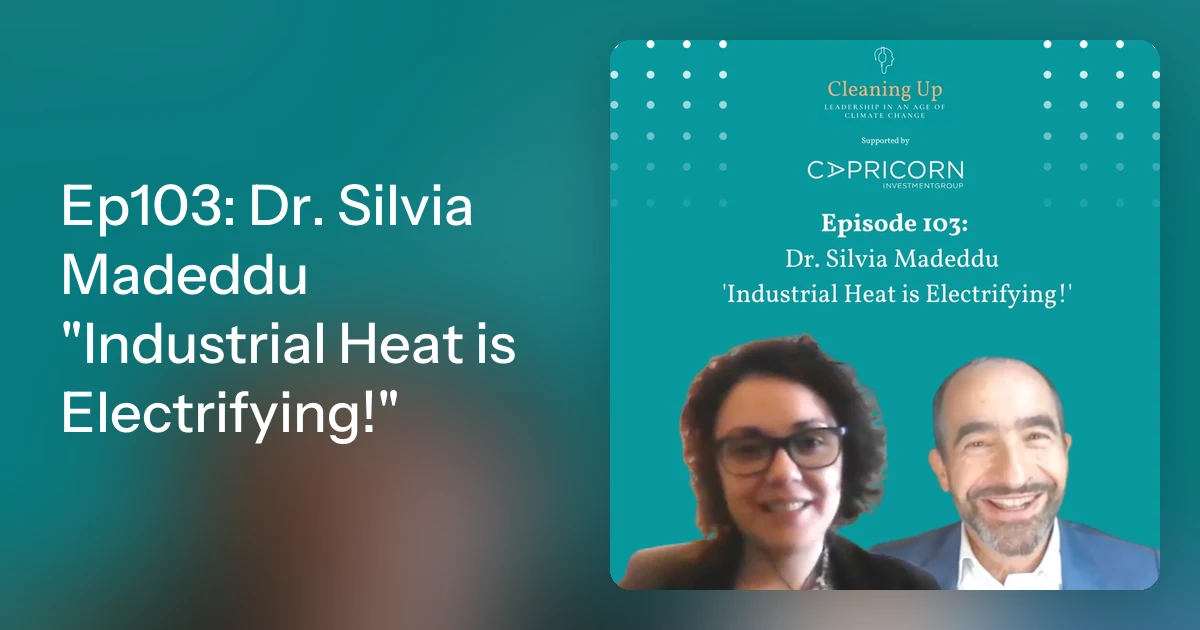
If you want to understand this better, maybe preparing for engagement, I recommend an interview that Michael Liebreich did in Oct 2022 with Dr Silvia Madeddu. She provides a really interesting insight into what we can do as investors.

But this is no longer just about industrial heat pumps. Let's finish with thermal batteries.
A thermal battery is an energy storage system that captures and stores heat rather than electrical energy. It typically uses materials such as molten salts, phase change materials (PCMs), graphite, or thermally conductive bricks to absorb and retain heat, which can then be released when needed.
An obvious application is industrial process heat. Put simply an industrial user can harvest low cost renewable electricity when it's cheap (and over abundant ie we are producing more than we can use) store it, and then use the heat when they need it.
If you are like me, you probably knew a bit about thermal batteries, but assumed that this was a technology that might be useful sometime out in the future. If you want to learn a bit more, there is a good Engineering with Rosie video on the technology, dating back to 2021.
But maybe this is a technology whose time is coming faster than we first thought. A recent Bright Spots blog from Jan Rosenow suggests that the technology is now moving from pilots to commercialisation. At which point it becomes interesting to mainstream investors.
 Jan Rosenow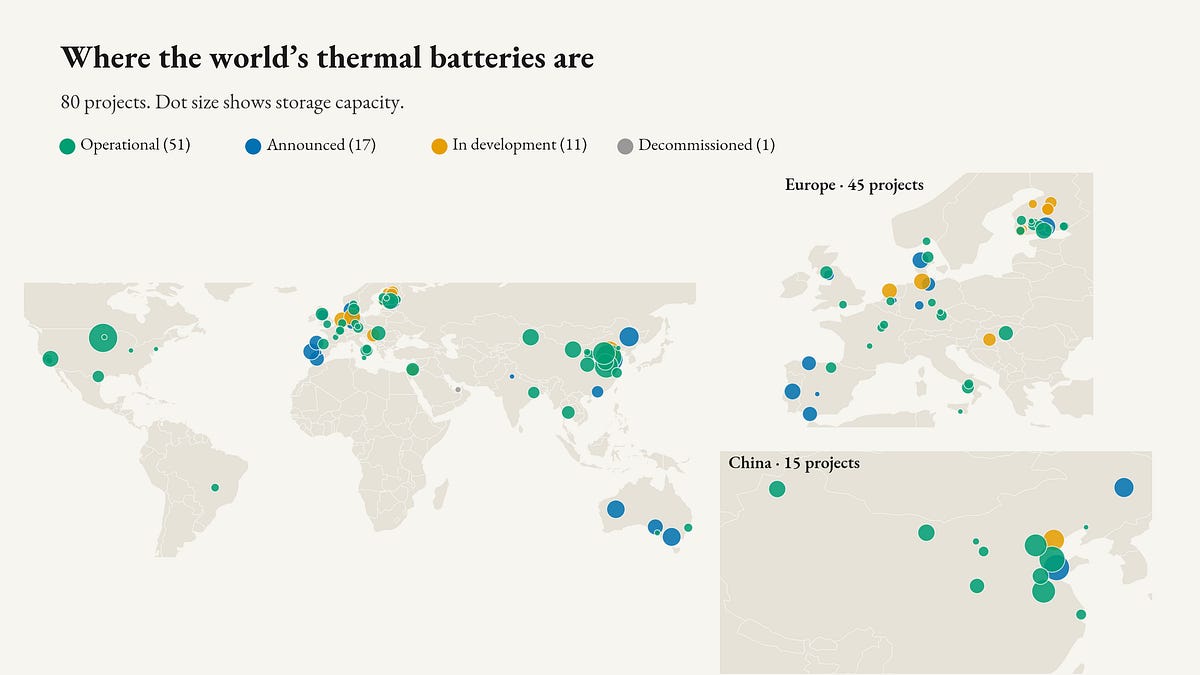
Taking a chart from the blog, the number of thermal battery operating projects is starting to grow. Not everywhere and not at scale, but something to watch.
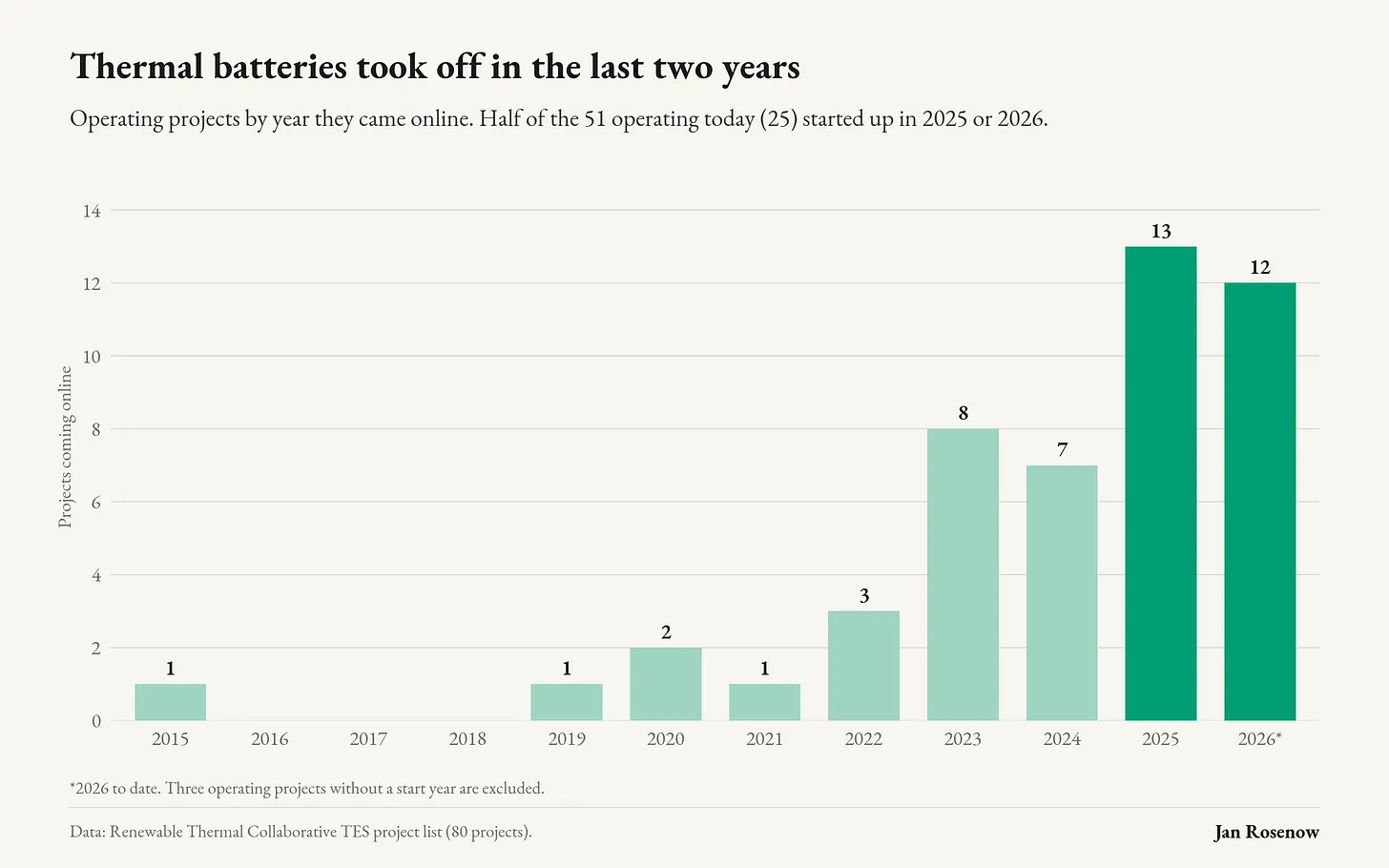
And this could be important as a Dec 2025 research paper suggested that integrating daily thermal storage could reduce the levelised cost of heat (LCOH) by up to 15% for heat pumps and 27% for electric boilers. The two technologies together could be worth more ?
One last thought
Solutions do not always have to involve new technologies. Using an industrial example, while decarbonising cement (and hence concrete) production should be our ultimate aim, in the meantime we can help by using less new concrete. Part of this will be from using other materials such as engineered timber, but we can also use less of it, while still achieving our design aims.
 Steven Bowen
Grant me the strength to accept the things I cannot change, the courage to change the things I can, and the wisdom to know the difference. Reinhold Niebuhr - a Lutheran theologian in the early 1930's
Please read: important legal stuff. Note - this is not investment advice.