Wednesday Brunch: who should act on deforestation ?
Deforestation is an important sustainability challenge. And it's one that investors should care about. What is less clear is how we can actually make a difference. Part of the answer is engaging with companies to prepare for & meet regulations. But can we (and should we) do more?

"If we tackle deforestation in the right way, the benefits will be far-reaching – greater food security, improved livelihoods for millions of small farmers, and indigenous people, more prosperous rural economies, and above all, a more stable climate." – Paul Polman, founder of Imagine.
The quote above, and many others like it, suggest that the main benefits from reducing (and then reversing) deforestation are to the wider society. Which suggests in turn that this is a challenge that needs a political and regulatory solution.
At one level this suggests that as investors our best course of action is to actively encourage companies to prepare to meet the 'new' laws, such as the European Deforestation Regulation (EUDR). And to prepare for likely upcoming regulatory changes and new legal precedent, especially in relation to human rights.
Some commentators argue that for investors this approach is the best use of our (often scarce) engagement resources ?
We argue that investors can go further, but this needs to be done with a full understanding of the complexity of the topic. And we need to understand that we are working toward very long term gains, a decade or possibly more out into the future. It's not as simple as just 'not cutting down anymore trees'.
Deforestation and the market vs policy debate.
Regular readers will know that there is a growing debate around what investors can realistically do to reduce climate change, and improve biodiversity & human rights. There is a growing body of well argued analysis that suggests that investors ability to influence change is more limited than many thought.
To quote Gosling, Hirt & Gimenes ... investors are now much less confident about is the idea that investors acting through targets, disclosure and stewardship alone can drive economy‑wide decarbonisation without supportive government policy.
This is leading to a growing view that as investors we need to move from a market‑led narrative (where investors, financial markets, and companies take the lead) to a policy‑led one (where governments and society lead instead). Under this second scenario, while investors can help drive change, it can only happen in the context of supportive government regulation and an appropriate legal framework.
By and large we mostly agree with this analysis. Thinking broadly, there are a fairly limited range of actions that we can reasonably expect companies to undertake. These include protecting and enhancing long term profitability, responding to expected changes in technology and changing customer demand, and of course meeting the letter and the spirit of appropriate laws and regulation.
What is a much harder ask is trying to get them to do things that reduce profitability. And trying to fix societies wider challenges, such as sustainability, would normally result in lower profits for the company. This is not a value judgement, it's a reflection of how our financial system works.
All of this means that in some cases our best approach to sustainability related change is via policy and regulation.
This is largely consistent with the advice on deforestation from well respected bodies such as the IIGCC . It's led by policy - that we require companies to prepare for, act on, and report back on progress.
 IIGCC
IIGCC
As they put it in their latest report summary, while there are some potential financial benefits, it's mostly about regulation ...
Forest loss intensifies physical risks, such as fires, droughts, and floods, which can disrupt operations and reduce agricultural yields across supply chains. Meanwhile, regulations are tightening across multiple jurisdictions, creating transition risks for companies with weak traceability and due diligence systems. Deforestation is also frequently linked to human rights violations, compounding exposure to reputational and legal risks. It also leads to systemic risks; deforestation contributes approximately 11% of global greenhouse gas emissions and is one of the largest drivers of terrestrial biodiversity loss.
BUT Deforestation is largely linked to agriculture
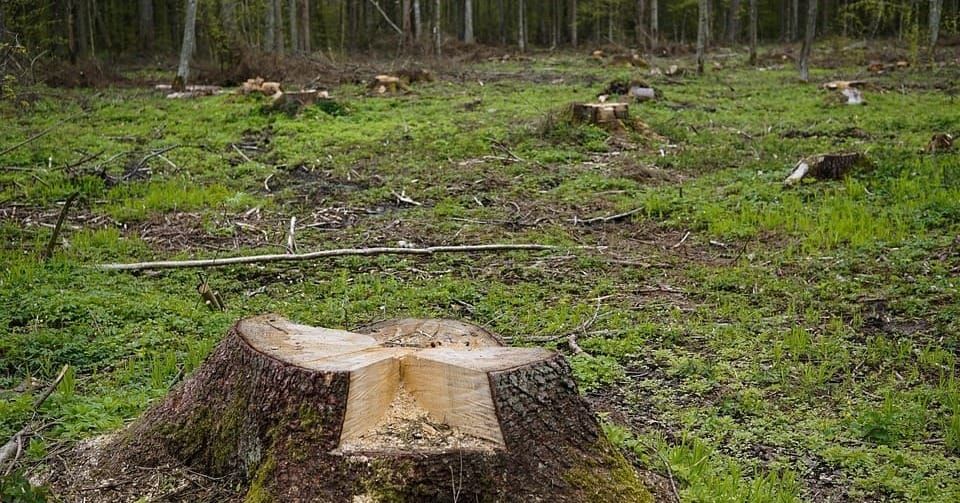
Deforestation doesn't normally happen because some companies decide to cut down some trees (obviously this excludes forestry - where logging of virgin forests is an issue). Ex forestry, it is largely linked to the expansion of agriculture. To quote a recent Our World in Data article ...
In just over 100 years the world lost as much forest as it had in the previous 9,000 years. An area the size of the United States. And we can see that this was driven by the continued expansion of land for agriculture. When we think of the growing pressures on land from modern populations we often picture sprawling megacities. But urban land accounts for just 1% of global habitable land. Humanity’s biggest footprint is due to what we eat, not where we live.
So maybe, from an investor perspective, part of the long term solution to deforestation can be found in helping to fix the sustainability and efficiency challenges in our food supply system.
Agriculture is a big GHG challenge
Setting the scale of the challenge, a recent World Bank report estimated that over 30% of global GHG emissions come from our food system. And of this a big chunk comes from net deforestation (what they call Net forest conversion).
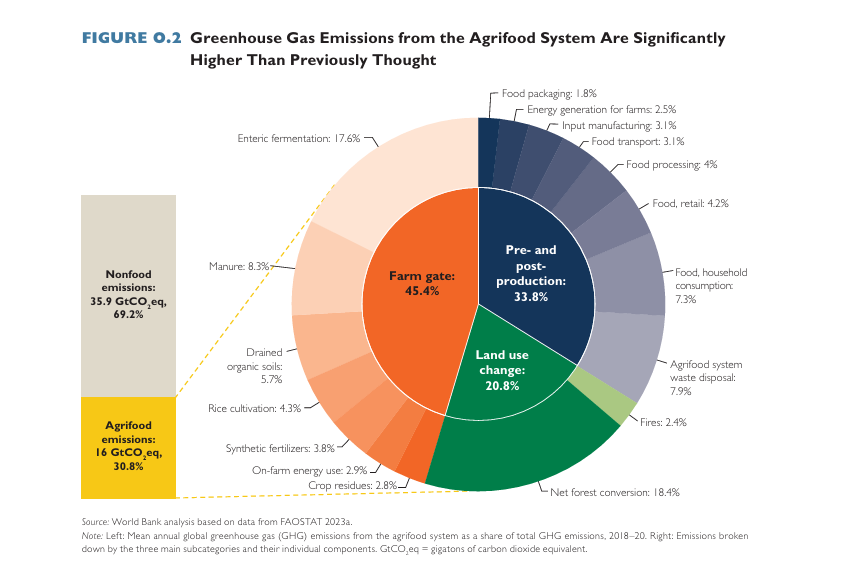
The impact of deforestation is estimated to be 18.4% of total agricultural emissions or around 5.6% of our total global emissions. This makes it nearly as big an emitter as road freight, and bigger than aviation and shipping. And it's a bigger challenge than cattle based methane emissions, if we exclude manure.
 Steven Bowen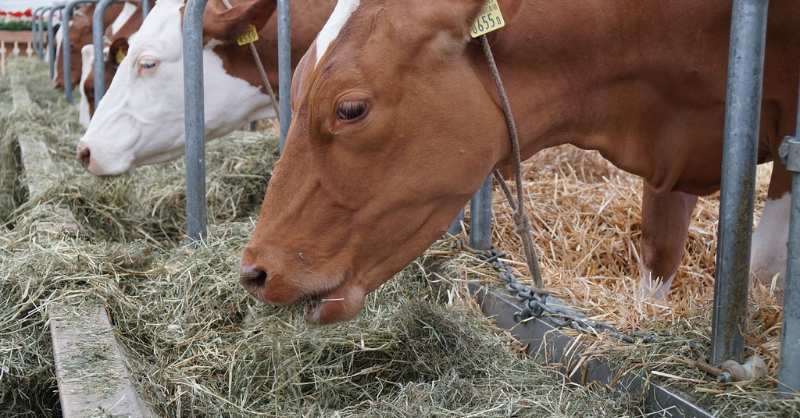
This means we should all agree that this is a challenge worth fixing. The question is how.
Maybe the solution is making agriculture more efficient ?
So, if we are cutting down more forests to produce more food, maybe the answer is getting more food from the same (or even better less) land. Meaning we don't need to cut down the trees !
This is where investors can legitimately make a difference. We can engage with companies to reduce waste in the supply chains (and post purchase). We can get them to help farmers raise yields (through better farming practices), producing more using the same land. And we can work with them to accelerate the shift to plant based diets.
 Steven Bowen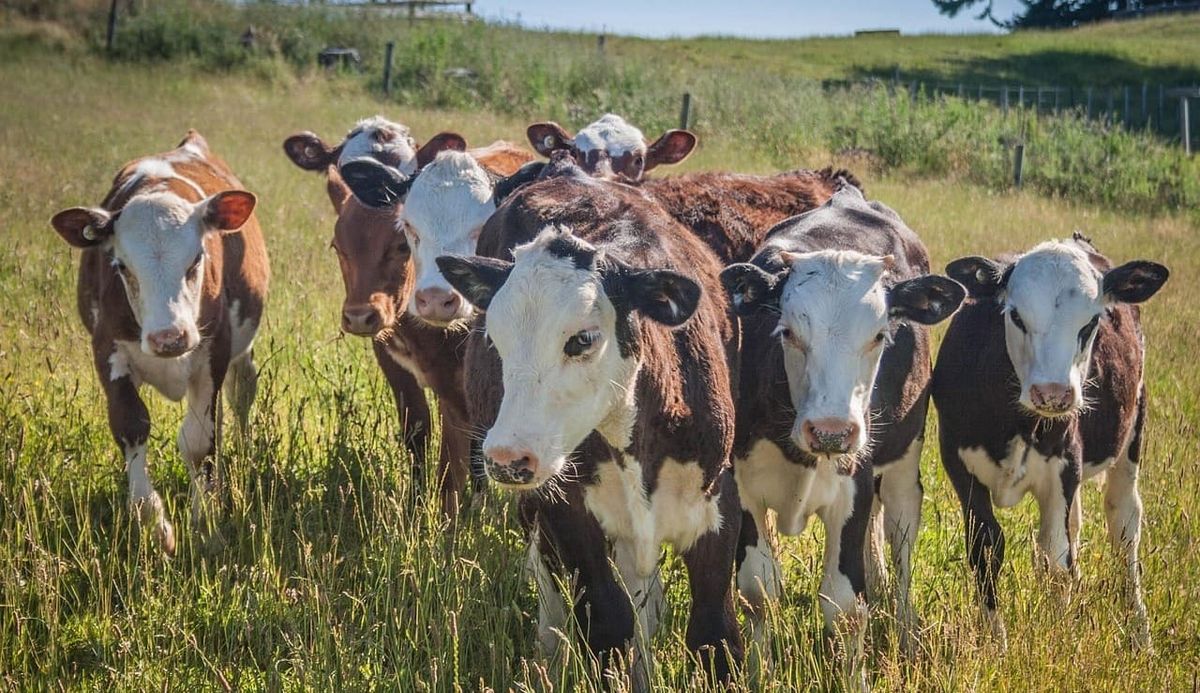
None of these actions are going to be quick and easy. Changing supply chains, improving farming practices, and shifting consumers to healthier diets will take a decade or more. The good news is that these actions will not only reduce deforestation, they can also be good for the companies that lead the change.
 Steven Bowen
The bottom line is that while getting companies to act on legal changes such as the European Deforestation Regulation is a really good thing to do, in parallel we can also engage on changing how our agricultural system works.
Yes, it's an engagement topic with a really long term horizon, but we may find that it ends up making as much difference as policy and regulation.
One last thought
It's well known that Europe is active in introducing regulation to ensure that products being sold in the region meet minimum human rights and environmental standards. Many companies are already preparing for the new rules and by and large the new rules are well supported by the general public, at least in principle.
But, little work has been done so far on the difference the rules will make in the exporting country. Will they lead to better human rights and environmental practices? Maybe not.
 Steven Bowen
Grant me the strength to accept the things I cannot change, the courage to change the things I can, and the wisdom to know the difference. Reinhold Niebuhr - a Lutheran theologian in the early 1930's
Please read: important legal stuff. Note - this is not investment advice.