Wednesday Brunch: Rice & GHG emissions
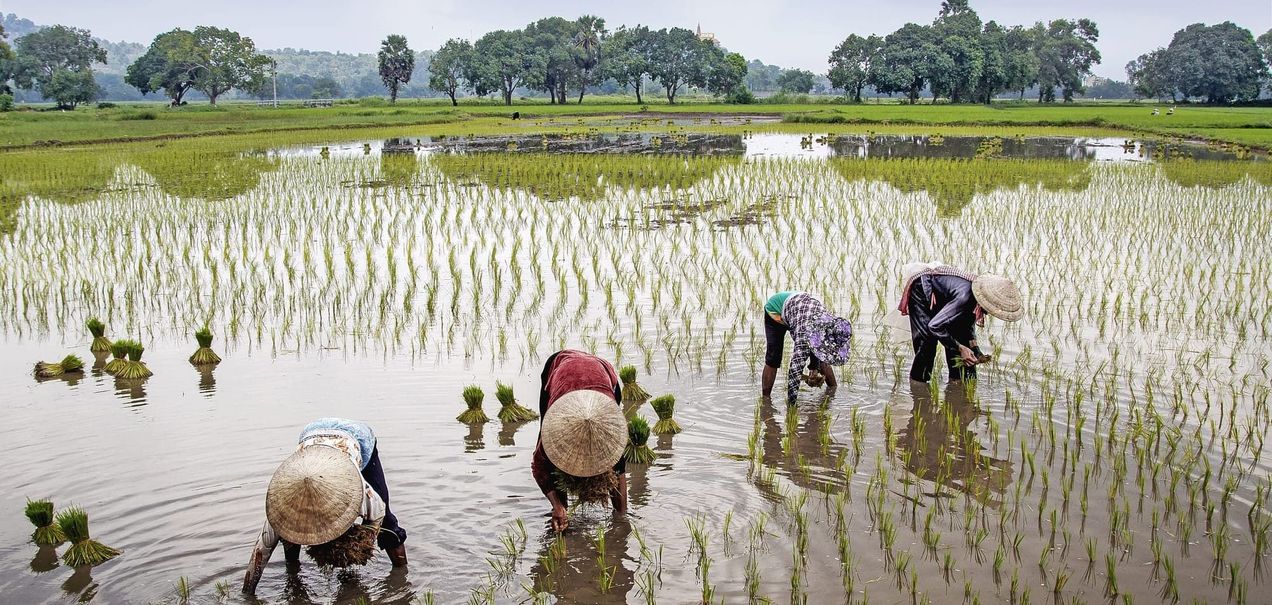
Over half of the world relies on rice as a daily food staple. It is also responsible for large amounts of methane emissions. And it consumes c. 40% of global irrigation water. But there is a better way to grow it - it's just scaling it up is tough. Which is where investors can play a part.

It is estimated that rice cultivation contributes c. 12% of man made methane emissions. And a recent study suggested that these have at least doubled and more likely tripled over the past six decades. While rice growing is not one of the largest contributors to GHG emissions, it's still material. And perhaps more importantly it's a challenge with a good solution, called Alternate Wetting & Drying.
Investors and companies have a key role in making it happen.
What is Alternate Wetting and Drying (AWD)?
Most rice growing involves using continuously flooded fields. AWD entails periodic draining of the field (rice paddy) to a certain threshold, usually 15 cm below the soil surface, and re-flooding. A perforated tube placed in the soil enables the farmer to monitor the water level below the soil surface to determine when to irrigate. That's it. Simple.
Ok, so it's not quite that simple, but it's not complicated to understand.

As research from the International Rice Research Institute points out ....the AWD technology has been proven to effectively mitigate greenhouse gas (GHG) emissions, specifically methane (CH4), from rice production by 30-70%, without causing a yield reduction. And it is a simple and inexpensive way of reducing water consumption in rice production by 30%.
What is really interesting for investors is that the solution doesn't involve new technology, or even massive levels of investment. It's all about spreading best practice. That sounds easy. But it's hard to do at scale. Hard but not impossible.
Barriers to rollout are not easy to overcome.
If it's that easy, and the benefits are clear, then how come it's not already happening everywhere?
Part of the challenge in rolling this out at scale relates to site specific factors, such as the fact that it works best on lowland finer texture soils that hold moisture. But arguably some of the biggest challenges relate to getting farmers to try it.
 Sustainability Directory
Barriers for farmers include technical issues such as the operation of irrigation systems and how water is paid for. But there are also very real concerns that drying the fields out will lead to crop failure, weed growth or lower yields. After all the traditional flooded field approach has been in use for decades (if not centuries). Change brings risk. And many farmers are not financially able to withstand risk.
But investors can help overcome the barriers
This is where investors and companies can play a part. By working with farmers, often over extended periods, we can encourage the rollout.
An example of this is the work of Tilda, the UK based rice company. They started to test AWD techniques in the field with a small group of farmers in 2021. By 2025, they had increased the number of farms in the programme to 3,840, covering 15,314 hectares. Benefits they have identified include lower GHG emissions, lower water and electricity (for pumps) usage, plus the farms use less fertiliser. And generate higher yields and hence farm incomes.

Is the solution perfect, well no. NO2 is a problem. When fields are no longer continuously flooded and the soil is increasingly exposed to oxygen, it encourages microbes to release N2O – especially in the presence of fertilisers applied to boost crop yields. And so the next set of work is to test whether using bio-fertilisers that contain mycorrhizal (AM) fungi could help reduce N2O emissions and nutrient run-off, and improve soil quality.

The point of this analysis is simple. Many of the sustainability challenges we face already have solutions, especially in agriculture. And many of these solutions don't need expensive and complicated technologies. Instead they face other, very real, social barriers. They need us to work with thousands of farmers on the ground to help them roll out best practice, and to understand and mange the risks.
We wrote about some of the work taking place in rice research in an earlier blog from Oct 2023. The opportunity is still there.
 Steven Bowen
One last thought
We can also make a difference to fruit and vegetable production. Disruptions to supply chains create a financial hit for companies in the food industry, especially if their competitors had planned ahead. Climate change will lead to disruptions, especially in countries already suffering heat & water stress. It's better to start planning for this now not later.
 Steven Bowen
Grant me the strength to accept the things I cannot change, the courage to change the things I can, and the wisdom to know the difference. Reinhold Niebuhr - a Lutheran theologian in the early 1930's
Please read: important legal stuff. Note - this is not investment advice.