Sunday Brunch: how human capital creates financial value
If we cannot explain how people add financial value, it's hard to get companies to adopt better human capital practices, and to get investors to take it seriously. The good news is that we have a framework, it's called Corporate Architecture - and in a way it's similar to good building design.

"Design is not just what it looks like and feels like. Design is how it works." – Steve Jobs
The ultimate test of a good corporate strategy is how well it creates value for it's stakeholders. And for investors this mostly means financial value.
Before I explore Human Capital some more I want to make it clear - talking about people (the soft side of business) is hard for me. I spent my career either as an engineer (numbers) or as an analyst and investor (more numbers). It's only in the last few years have I got totally comfortable with the notion that it's people who create value, and so to understand what makes a good investment, we need to think more about people.
A couple of weeks ago I wrote about how hard it is to measure Human Capital. It doesn't really appear in a companies financial reports, which makes it different from other intangible assets such as innovation and brands.
 Steven Bowen
And this makes it easy to 'argue' that if we cannot measure it, we cannot include it in our valuations and investment cases. Which has two implications.
First, it implies that we cannot use ideas around human capital to help us find investments that will deliver superior performance (alpha). And second, we do not have the tools to get companies to implement better human capital practices, which would allow them to create more value. This second point is especially important for those investors who primarily use index trackers.
But is this correct?
Just because something is not in the financial statements, doesn't mean it's not material for financial value creation. A good example of this is management capability.
We know what good management looks like.
One definition is that a good management team is better at identifying and delivering value creating investment opportunities, what we call 'capital allocation'. Michael Mauboussin recently described capital allocation as "one of management's prime responsibilities".

As with Human Capital, management capability in capital allocation is something we can only measure after the event. We only really know how successful an investment by a company has been once we see the results coming through.
BUT, we don't say 'we cannot measure it in advance and so we can ignore it'. Instead, we find processes that allow us to include it in our forecasts. They may be imperfect but they are better than pretending management expertise is not important.
I would argue that Human Capital is similar.
But, to include it in our financial evaluations, we need to be clearer about how it impacts financial outcomes.
This is where the work of Professor John Kay comes in. Back in the early 1990's he published a book titled Foundations of Corporate Success: how business strategies add value. I was lucky enough to have Professor Kay as one of my lecturers when I did my MBA, which was around the time his book was published.
I would like to be able to say that I understood what he was getting at. But sadly I did not. For reasons that make no sense to me now, I saw financial analysis (which I wanted to do) as being separate from corporate strategy. Luckily I am less stupid now (or maybe just stupid in different ways).
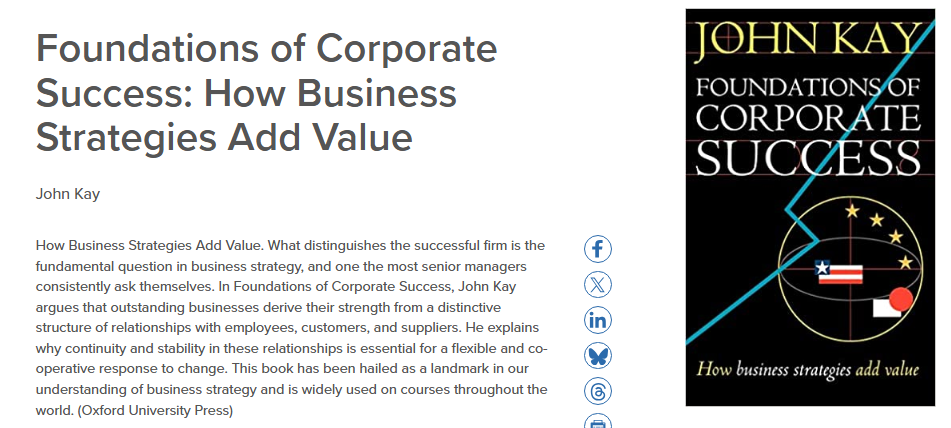
I don't intend to precis the entire book, today I just want to highlight one of the three sources of distinctive capability (or competitive advantage) that he saw companies as possessing - Architecture.
He defines Architecture as being the network of relationships that exist both internally (people) and externally (suppliers and customers). And he makes the point that these strong relationships are what enable companies to create organisational knowledge and routines, and to respond flexibly to changing circumstances.
These relationships are hardly ever written down. it's perhaps impossible to define them in a way that allows them to be written down, they are too fluid. And ironically, this is what makes them value creating. They are hard to copy and are often unique to a particular company.
Putting it another way, architecture it is what makes a company worth more than the sum of it's parts. We can think about good architecture in the way that Billy Beane ran the Oakland Athletics, made famous in the Michael Lewis book Moneyball, the art of winning an unfair game. In the book Lewis describes how Beane created a winning baseball team by combining players in a way that made the team better than the sum of it's parts. All at a lower cost than their opponents.
And to carry the analogy a bit further, it's a bit like good building architecture. Architect's all use the same materials, what makes a good architect is how they combine them to produce what we call good design.
So a quick recap
Human Capital is similar to other intangible assets in that it enables companies to creates value. But it's also different from say innovation and brands in that it's hard to find in a companies financial statements. In this sense it has a lot of similarities with management capability, we know it makes a real difference, but we can only measure how much difference it has made after the event.
Human capital is about human relationships, the links that people build with other workers, their bosses, their suppliers and customers, and the wider community.
And it's this last point that gives us some clues as to how we can measure it, and maybe even predict it's impacts. If human capital contributes to a company having a good Architecture, and a good architecture is about human networks and relationships, maybe a good place to go next is to explore what is called workplace wellbeing - or how we feel at work and about our work. Logic tells us there should be a link between human capital, good corporate architecture, and workplace wellbeing? This is something I want to explore some more in a future blog.
One last thought
Hoping that incumbent companies will change can lead to disappointment. Incremental is ok, but big changes sometimes need a new entrant. Incumbents have too much to lose. So maybe our first question should be 'will the incumbents deliver the change we want or do we need creative destruction'?
Professor Kay makes the point that good corporate architecture is easier to sustain than it is to build from scratch. Which is perhaps a different way of saying, many incumbent companies are often organisationally incapable of change, at least at scale.
 Steven Bowen
Grant me the strength to accept the things I cannot change, the courage to change the things I can, and the wisdom to know the difference. Reinhold Niebuhr - a Lutheran theologian in the early 1930's
Please read: important legal stuff. Note - this is not investment advice.