
Sunday Brunch: human capital, the hidden investment factor ?
Financial markets can be very efficient, but they can also struggle to absorb some types of competitive advantage information. Human capital is a good example, which makes it a useful blind spot for both sustainability and financial investors.

"People are definitely a company's greatest asset. A company is only as good as the people it keeps." — Richard Branson
But if people truly are a companies greatest asset, how come we don't have a structured way of including them in our investment appraisals and valuations ?
One possible reason is that Human Capital isn't really reported at all in our current accounting structure. It's not in the P&L, the Balance Sheet or the Cashflow. So we don't have numbers we can add to our appraisal, as we do for tangible investments, and for brand building and R&D/innovation.
But, is that a good reason to exclude it (and then wonder why companies don't invest enough in their people?).
Maybe we just need to look in different places.....
Share prices move when financial markets 'discover' new information. In some cases the link is easy to understand, better than expected profits, often from higher value creating investments in physical assets (such as data centres) or some intangible assets (brands or R&D), can often result in share prices spiking up.
But, the financial markets seem to struggle with one specific type of investment - human capital (or in non investor speak - people).
Human capital is really important for sustainable investors, it broadly underpins everything positive that companies do. It's probably not too much of an exaggeration to say it's the glue that makes all other sustainability related investments valuable and productive.
Plus it's important on it's own. Strong human capital companies can be more open to new opportunities (including green investments that push the transition along), and they can also be better citizens (recognising the long term benefit from treating employees well, and having good relationships with local communities and stakeholders). Plus they are better positioned to develop deeper relationships with customers and suppliers, relationships that offer improved long term benefits for both parties.
This can result in companies that are more resilient (better able to cope with what ever it is their environment throws at them). And it can make them more profitable than the market expects (and sometimes a lot more profitable than their peers).
Strong human capital companies can therefore potentially make good investments from a financial perspective, as well as making a more positive impact on society.
I appreciate that these are bold claims. And normally I would start by setting out the evidence as to how & why strong human capital companies are able to create this value. Or putting it another way, what is their extra source of competitive advantage.
But for now I ask that you take this on trust - I promise to come back to the evidence (in detail). But for now I want to start with a very basic question that all investors should ask ...
If Human Capital is such a strong generator of financial value, why is the market not already pricing it in ?
If we cannot answer this question, then it's going to be hard to persuade asset managers/investors that they need to give Human Capital more attention, at least from a purely financial perspective.
To set out our answer, we need to start with some valuation basics and a better understanding of intangible assets (which from a financial perspective is what Human Capital is).
This is the first in a series of blogs on Human Capital. Understanding it's impact on the financial strength of companies, and it's importance to sustainability investors, is a complex task. Rather than rush and shorten this, I will be covering the various key topics over a series of posts. And I want to be clear, I am not an expert on workplace wellness, or how to build robust relationships in supply chains, or any of the myriad other places were the actions of people make a material difference. I am simply an investor, someone who cares about the financial impact that these actions create. And how as sustainability focused investors, we can help companies be better.
It all starts with efficient markets - I have pointed out in the past that financial markets are pretty good at incorporating certain information (efficient markets hypothesis). Which means that a lot of the time a companies share price fairly represents all of the currently available information about the companies future profits. Which is why it's hard for active investors to beat the market, at least consistently.
 Steven Bowen
But beating the market (what the finance industry calls generating alpha) is what most asset managers try to do every day. If they cannot beat the market (or more strictly the benchmark they use) then why would asset owners (their clients) give them capital to invest? It would be way more cost effective, and better for financial returns, just to buy an index tracker.
When an asset manager buys a share, they are effectively saying - I have more positive expectations about the future of this company than the market does. And this more positive view can lead to material share price movements. Taking an example from today (today being Wednesday when I started the draft of this blog)...
La-Z-Boy Inc. (NYSE:LZB) shares jumped 17.66% to $41.25 in after-hours trading Tuesday after the furniture maker reported fiscal fourth quarter results where earnings per share and revenue both topped analyst estimates.
The challenge for asset managers is that they need to be ahead of these share price movements, which means they need 'prompts' that tell them that the market consensus is too low. This might be for the next quarters results, or it could be for the next few years (or longer). Basically they need to forecast a different future for the company than the one that the market is currently expecting.
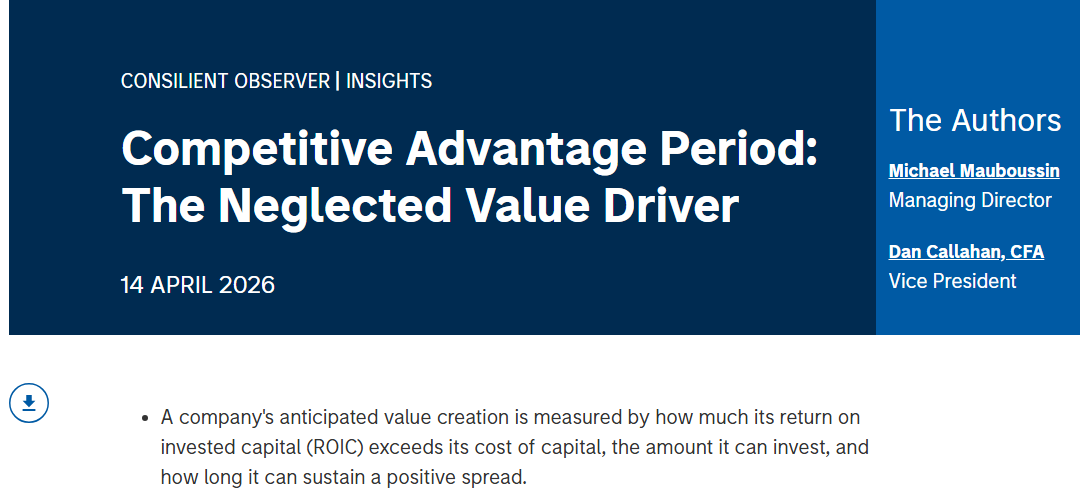
Forecasting future profits using ROIC - One useful way to do this is to look at what investments the company is making, and what financial return it is getting on them (Return On Invested Capital or ROIC). If we add to this a good understanding of how long the company can sustain that ROIC (what we call the fade), then we can make a good estimate of future profits. Mauboussin & Callahan have a really good explanation of this process that is well worth a read.
One immediate challenge is identifying what we mean by an investment. Back in history, this was easier. Investments were money spent on factories, or trucks, or machinery - physical things that we call tangible assets. But the days when a companies investments are dominated by spending on tangible assets are now long gone. Now its all about investing in R&D, Brands and other intangible assets.
The often quoted Ocean Tomo analysis estimated that in 2025 c. 92% of the value of an average company in the S&P 500 could be explained by intangible assets, up from only 17% in 1975.
The bad news is that our accounting frameworks have not really kept up with the shift to spending on intangibles. To quote the IFRS standard on intangible assets (IAS 38) .... "expenditure for an intangible item is recognised as an expense."
In other words, it's included in the P&L. This is different from spending on tangible assets, where its normally pretty straightforward to find the amounts invested in the cashflow statement and balance sheet.
Given that intangible assets explain the majority of most companies financial value, this is potentially a problem.
The good news is that for some intangible assets investors have workarounds. We can use our judgment to estimate which operating costs that accountants have put into the P&L are actually investing spend on intangible assets. These adjustments can include R&D, brand building (what is known as advertising and promotion or A&P spend), and even some elements of a companies SG&A (Selling, General and Administration) spend.
Again Mauboussin & Callahan have written a useful thought leadership report on this. Plus Iqbal, Rajgopal, Srivastava, and Zhao, have written a more detailed working paper on this entitled “Value of Internally Generated Intangible Capital.
The bad news as far as Human Capital is concerned, is that no such workaround exists. In fact, other than some small amounts spent on staff training, and the costs of providing various benefits, it's hard to think of how investments in Human Capital will appear in a companies financial reporting. So, from a financial analysis perspective there is nothing meaningful to find. And hence nothing meaningful to value.
Does that mean that Human Capital is not real? Not at all. But to find out how to include this in our financial analysis we need to look outside the world of finance and economics - we need to turn to strategy, human resources, psychology and organisational studies. Researchers in these fields have been analysing workforce wellbeing, and the importance of people and their relationships on business success, for decades.
Maybe it's time we started learning from other professions, not just because what they have learnt can help make better (and more sustainable) companies, but also because it makes financial sense.
For the next blog on this I plan to start with Professor John Kay's book from the early 1990's, The Foundations of Corporate Success. And then I want to draw on more recent work by academics such as Professor Alex Edmans, Professor Rebecca Henderson and others. Researchers who argue, based on detailed analysis, that it's people who make businesses successful. And to be better investors we need to understand how this works.
Or putting it another way, maybe the biggest real and sustainable financial value creator is Human Capital. And it's hiding in plain sight.
One last thought
What a company is worth to most investors comes from how much financial value it creates, which mostly is driven by future investments. In financial speak the most important part of this is a companies competitive advantage period (CAP). Sustainability issues are an important driver of how long this will last.
Many of the things that companies do that we think about as value creating are actually copyable. Operating processes, routes to market, and brands can be replicated by competitors. And yet somehow the competitive advantage that some companies creates gets sustained for decades, well beyond the time span we might expect. Understanding how this happens can identify underappreciated investments.
 Steven Bowen
Grant me the strength to accept the things I cannot change, the courage to change the things I can, and the wisdom to know the difference. Reinhold Niebuhr - a Lutheran theologian in the early 1930's
Please read: important legal stuff. Note - this is not investment advice.